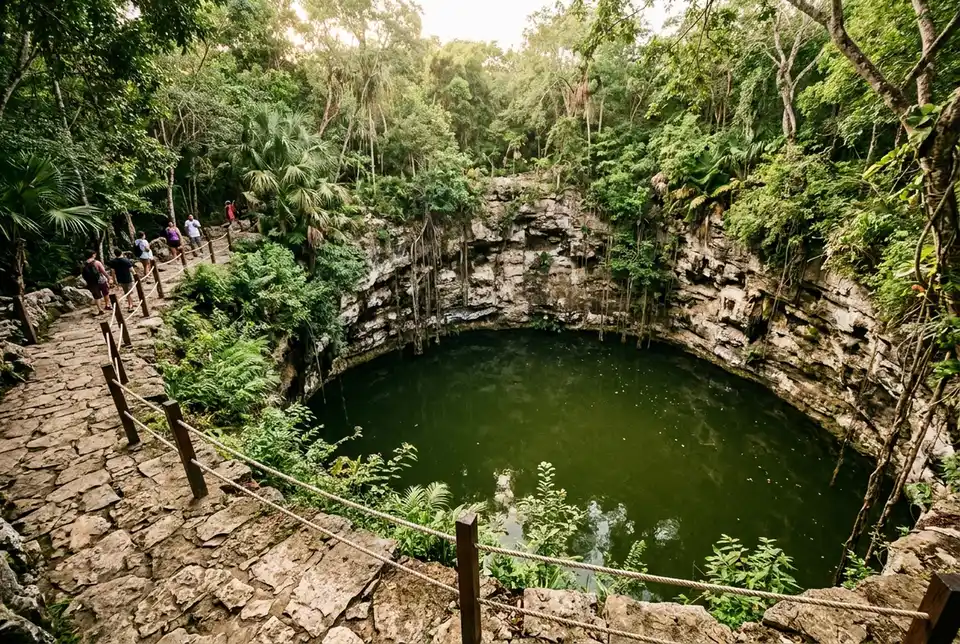
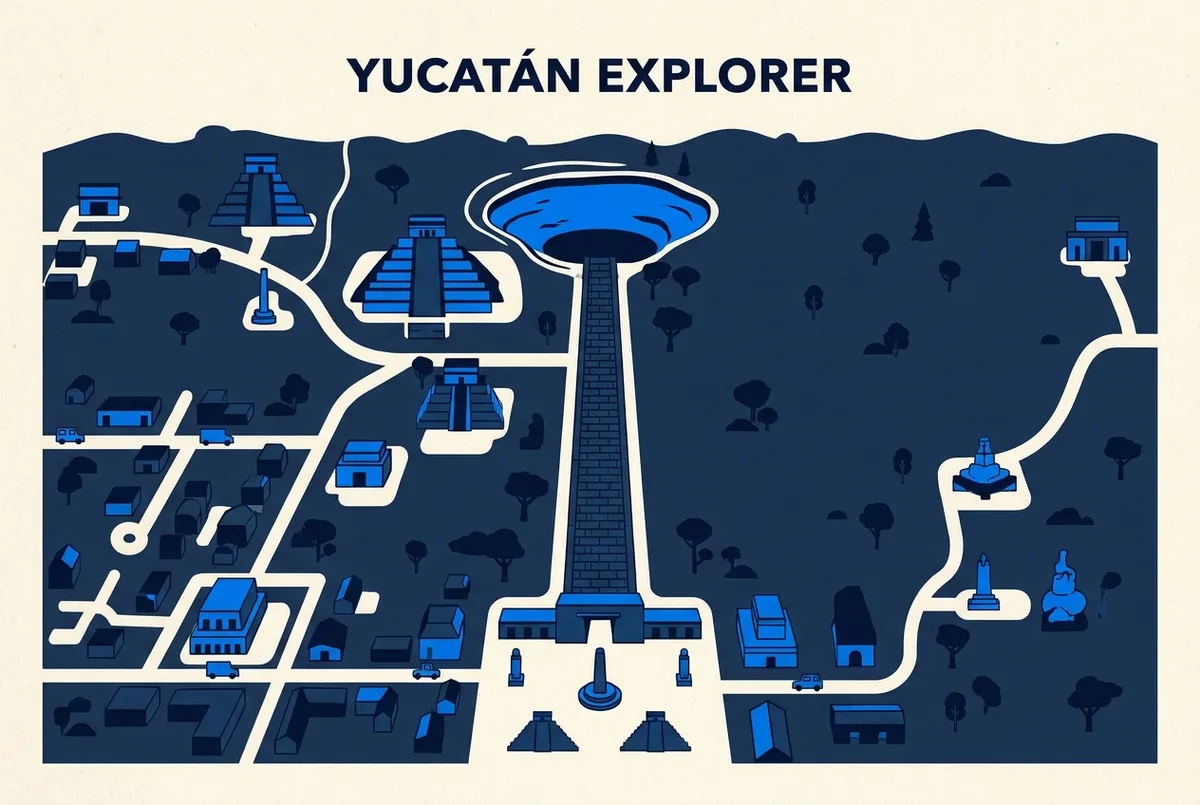
The sacred cenote at Chichen Itza, called Cenote Sagrado, sits a short walk north of El Castillo along a raised stone causeway, and I think it is one of the most sobering stops on the entire site once you know what it was actually used for. Unlike the postcard-pretty swimming cenotes scattered around the Yucatan, this one served a ceremonial purpose: it was a place where the Maya made offerings, including valuable objects and human remains, to Chaac, the rain god, during times of drought or crisis. Here is what I would want to know before standing at the railing looking down into that dark green water.
What is the Sacred Cenote, exactly?
The Sacred Cenote is a large natural sinkhole, roughly 60 meters across, formed where the limestone bedrock collapsed into the water table below. It sits at the end of a nearly 300-meter stone causeway leading north from the main plaza, a deliberate architectural choice that tells you how important this specific cenote was to the city’s religious life. The drop from the rim to the water is steep and the water itself is deep and murky, a detail that matters once you understand what archaeologists eventually pulled out of it.
Check prices & dates
Ready to visit?
Book your tickets in advance: popular time slots sell out.
Early 20th-century excavations recovered a huge range of offerings from the cenote’s bottom, including gold discs, jade beads, carved wood, copal incense, and the remains of both animals and people. I would be careful not to picture nonstop mass sacrifice, since current scholarship reads this more as periodic ceremonial offering tied to drought and agricultural anxiety than a routine practice. Still, the recovered human remains are real, and the “well of sacrifice” label stuck for a reason even if the full picture is more complicated than the nickname suggests.
Who actually dredged the cenote, and when?
Edward Thompson, an American who purchased the Chichen Itza estate in the late 1800s, led the major early dredging effort in the early 1900s, using a dredge bucket to pull material up from the cenote floor. I find his story almost as interesting as the artifacts themselves: he shipped a large share of what he found back to the United States before Mexican authorities caught up with the legal fallout, and some of those pieces are still held abroad today, a point of ongoing cultural debate. Later, more careful archaeological dives in the mid-20th century recovered additional material using proper underwater survey methods rather than a dredge.
Can you swim in the Sacred Cenote?
No, absolutely not, and I would be suspicious of anyone who tells you otherwise. The Sacred Cenote inside the archaeological zone is fenced and protected, viewed only from the surrounding path, both for preservation reasons and because its depth and murky water make it unsafe regardless. If a swimmable cenote is what you are actually after, Ik Kil and the cenotes around Valladolid are the ones built for that, and this site covers the full roundup of swimmable cenotes near Chichen Itza separately, since they are a completely different kind of site from this one.
What did the offerings found there actually tell archaeologists?
The range of materials, gold and jade from as far as Central America, points to Chichen Itza’s reach as a trading and religious center well beyond the immediate Yucatan region. I think this is the real takeaway for most visitors: this one cenote is physical proof that Chichen Itza was not an isolated city but a hub connected to a much wider Mesoamerican world. The human remains recovered also shifted how historians think about the scale and nature of Maya ritual practice at the site, moving the conversation away from exaggerated colonial-era accounts toward a more evidence-based picture.
Why does the cenote sit so far from the main plaza?
The nearly 300-meter causeway connecting the plaza to the cenote was clearly a deliberate design choice, not an accident of geography, since Chichen Itza’s builders routinely reshaped terrain to suit ceremonial needs elsewhere on the site. I think the distance itself was part of the ritual: walking that stretch of raised stone, with the main pyramid receding behind you and the dense jungle closing in around the path, would have set a very different mood than standing in the open plaza. Processions heading to the cenote for an offering ceremony likely used that walk as a transition, physically and psychologically, from the city’s public religious center to its most sacred and secretive one.
How does the Sacred Cenote compare to a swimming cenote in appearance?
Visually, the difference is immediate. Where Ik Kil or Samula greet you with clear turquoise water, hanging vines and sunlight filtering through an open or partially open roof, the Sacred Cenote is darker, more closed in by surrounding jungle, and noticeably more still. I would not go in expecting a beautiful photo the way you might at a swimming cenote, since the whole point of this stop is historical weight rather than visual spectacle. The water itself carries a greenish, almost murky cast that, once you know its history, feels appropriate rather than simply unattractive.
Is the Sacred Cenote worth walking out to see?
I would say yes, even though it is visually less dramatic than a turquoise swimming cenote. Standing on that causeway, knowing what was pulled from the water below, gives the stop a weight that the more photogenic parts of the site do not carry. I would budget ten to fifteen quiet minutes here rather than rushing through on the way to somewhere else, since this is one of the few spots at Chichen Itza where the history feels less like a plaque and more like something real happened exactly where you are standing.
This site’s full facts and history guide covers where the Sacred Cenote fits into the city’s broader timeline, and my piece on El Castillo and the equinox shadow covers the site’s other major astronomical and ceremonial centerpiece. For the Observatory and Great Ball Court, which round out the site’s major structures, I cover those together in my guide to Chichen Itza’s other structures. You can read more on the artifacts and excavation history on Wikipedia.
Every Chichen Itza tour that includes a guide will walk you past the Sacred Cenote as part of the standard route, so you do not need to seek it out separately, just budget the extra few minutes to actually stop and take it in rather than walking past.
Were other cenotes at Chichen Itza used the same way?
Chichen Itza actually has a second, smaller cenote closer to the city’s residential area, generally referred to as Xtoloc, which seems to have served a more practical purpose, likely supplying drinking water for the population rather than ceremonial offerings. I find the contrast useful for understanding the site as a whole: a working city needed everyday water, and the Sacred Cenote’s separate, ceremonial role only makes sense once you realize it was not the city’s only water source. I would mention Xtoloc if your guide does not bring it up, since it is an easy way to see how the city balanced the practical and the sacred within the same urban plan.
My honest take on this stop
I would treat the Sacred Cenote as one of the most underrated parts of a Chichen Itza visit, precisely because most people walk past it quickly on their way to photograph El Castillo. If you only have time to really absorb two or three stops on site, I would put this one on that short list, specifically because a guide explaining what was found there adds far more than the view alone does. Skip the self-guided ticket if this kind of context matters to you, since a bare entry ticket will not tell you any of this on its own.
FAQ: The Sacred Cenote at Chichen Itza
What is the Sacred Cenote at Chichen Itza used for?
It was a ceremonial sinkhole where the Maya made offerings, including valuable objects and human remains, to the rain god Chaac, particularly during droughts.
Can visitors swim in the Sacred Cenote?
No. It is fenced off and viewed only from a surrounding path, both for preservation and because the deep, murky water is not safe for swimming.
What was found inside the Sacred Cenote?
Gold discs, jade beads, carved wood, copal incense, and the remains of animals and people, recovered mainly through early 1900s dredging and later archaeological dives.
Is the Sacred Cenote included on a standard Chichen Itza tour?
Yes, it sits along the main visitor route a short walk from El Castillo, so any guided walk through the site passes it.
I would not skip this stop just because it lacks the turquoise-water appeal of a swimming cenote, since understanding what it represents changes how the rest of the site reads once you keep walking.