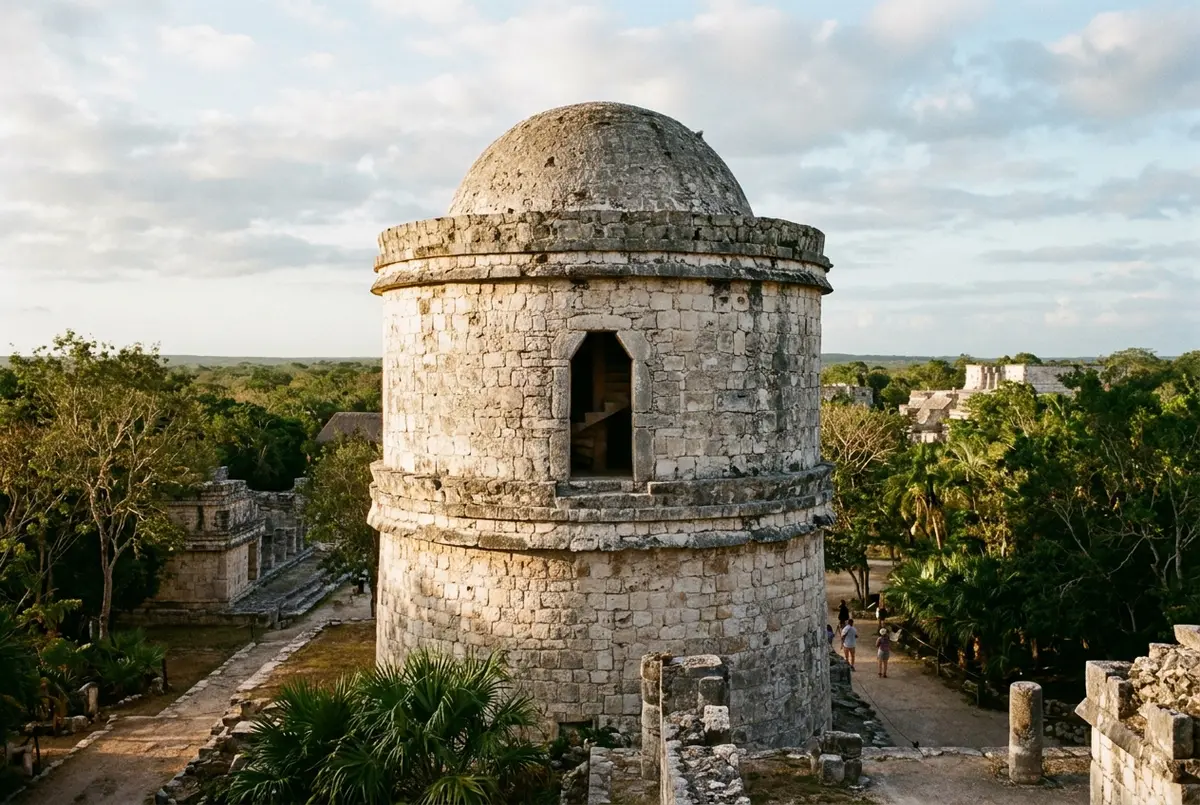
The Chichen Itza ball court and observatory rarely get the attention El Castillo does, and I think that is a genuine mistake, because both tell you more about daily Maya life and science than the famous pyramid ever will on its own. El Caracol, the round observatory, and the Great Ball Court, the largest in Mesoamerica, sit on opposite sides of the site’s priorities: one tracked the sky, the other hosted a ritual sport that shaped the city’s social and political life. Neither pulls much search demand on its own, so I am covering both together here, the way I would if you asked me what else is worth your time on site.
What is El Caracol and why is it round?
El Caracol, Spanish for “the snail,” gets its name from the spiral staircase winding up through its interior, a genuinely unusual shape for Maya architecture, which otherwise leans heavily on rectangular, stepped forms. I find the design itself almost as interesting as its function, since round buildings are rare across the Maya world and this one clearly needed that shape to serve its purpose as an observatory.
What was El Caracol actually used for?
Astronomers studying the structure have matched several of its window openings to the rising and setting positions of Venus, along with other solar and lunar alignments, strongly suggesting Maya priests used it to track celestial cycles tied to agriculture and ritual timing. I would think of it less as a casual stargazing spot and more as a precision instrument, since Venus’s cycle in particular mattered enormously to Maya timekeeping and was linked to decisions about warfare and ceremony. The structure sits a short walk south of the main plaza, past the Temple of the Warriors.
How big is the Great Ball Court, really?
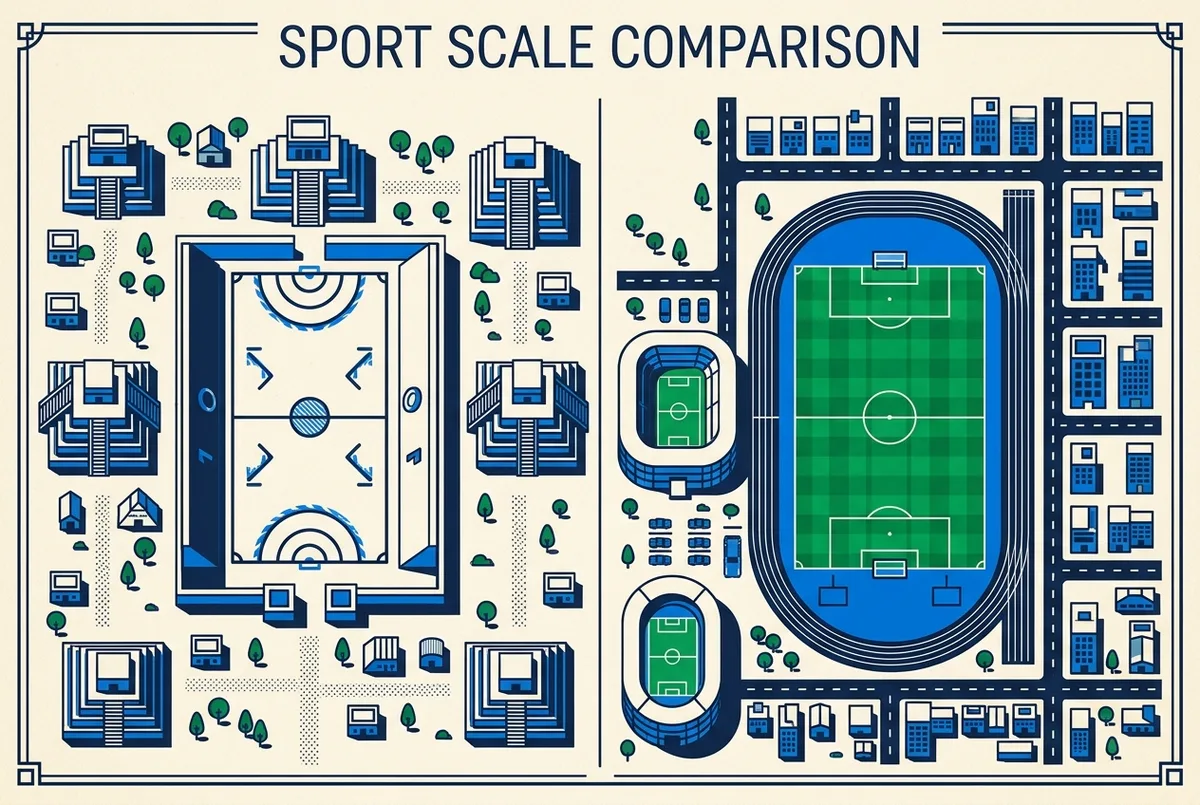
The Great Ball Court at Chichen Itza measures roughly 168 meters long and 70 meters wide, making it the largest confirmed ball court anywhere in Mesoamerica, well beyond the dozens of smaller courts found at other Maya and Aztec sites. Standing inside it in person is a different experience than any photo conveys, since the scale genuinely surprises most first-time visitors expecting something closer to a modern sports field. I would walk the full length of it at least once rather than just glancing in from one end.
Is the whispering or acoustic effect at the ball court real?
Yes, and I think it is one of the more delightful, low-key surprises on site. A clap or a spoken word from one end of the court can carry with unusual clarity to the opposite end, a result of the parallel stone walls and the court’s specific proportions rather than any added technology. Guides often demonstrate this directly, and I would ask yours to do it if they do not offer on their own, since it is a quick, memorable moment that photos cannot capture.
What were the actual rules of the Maya ball game?
The game, often called pok-ta-pok today, involved moving a solid rubber ball using the hips, shoulders and torso, never the hands or feet, with the goal of passing it through stone hoops mounted high on the court’s side walls. I would picture something closer to a demanding, full-contact sport than a casual pastime, since the rubber ball itself was heavy enough to cause real injury. Carved relief panels along the court’s lower walls depict players and ritual imagery connected to the game, including scenes that have been interpreted as symbolic decapitation, though scholars still debate exactly how literally to read that imagery.
Why does this court matter beyond the game itself?
Because the ball game carried real political and religious weight in Maya society, tied to ideas about cosmic order, sacrifice and elite status, not just entertainment. I think that context is what turns the Great Ball Court from “big empty space” into one of the most meaningful stops on site once a guide walks you through the carvings along its base. Skipping a guide here specifically means missing almost everything that makes this structure interesting beyond its size.
Are there other structures near the ball court worth noticing?
The Temple of the Jaguars sits built into one of the ball court’s end walls, overlooking the playing field, and I would glance up at it as you walk past, since its carved columns and jaguar imagery connect directly to the ceremonial weight of the game itself. A smaller skull platform, the Tzompantli, also sits nearby, decorated with rows of carved skulls that most guides will point out as evidence of the site’s darker ritual practices. I would not skip either of these on your way between the ball court and El Castillo, since both take only a minute or two to appreciate and neither gets its own dedicated stop on most itineraries.
How does El Caracol compare to other Maya observatories?
El Caracol is one of the better-preserved and more thoroughly studied astronomical structures in the Maya world, and I think that is part of why it draws serious attention from archaeoastronomers even though casual visitors often walk past it quickly. Other Maya sites have structures believed to serve similar sky-tracking purposes, but few combine the clear physical evidence, the matched window alignments, with as well-documented a connection to a specific planet’s movement. I would treat a stop here as a chance to see Maya science in a way most other ruin sites in the region cannot quite match.
Do most tours actually stop at both El Caracol and the ball court?
Most guided walking routes include the Great Ball Court, since it sits close to the main plaza and El Castillo on the standard path. El Caracol, a little further out, gets included on most full guided tours but can get rushed or skipped entirely on a tight self-guided visit if you are short on time or energy in the heat. I would prioritize the ball court if you have to choose, simply because of how central the ball game was to the city’s identity, but I would try to fit in both if your schedule allows.
This site’s facts and history guide ties El Caracol and the ball court into the city’s wider timeline, and my pieces on El Castillo’s equinox shadow and the Sacred Cenote cover the site’s other major landmarks in the same detail. If you are still deciding whether a full visit is worth the heat and the crowds, my honest answer on whether Chichen Itza is worth it covers that directly. You can read more about the ball game’s wider Mesoamerican context on Wikipedia.
A guided Chichen Itza tour is the easiest way to make sure neither structure gets skipped, since a good guide paces the walk so you reach both before fatigue or heat cuts the visit short.
My take on what to prioritize if you are short on time
If I only had two hours on site, I would spend them on the main plaza, El Castillo, the Great Ball Court and its carvings, in that order, since that combination covers the site’s biggest visual and historical payoff fastest. El Caracol is worth the extra walk if you have a third hour, especially if astronomy genuinely interests you, but I would not feel guilty skipping it on a rushed visit the way I would feel skipping the ball court. For most first-time visitors, I think the ball court’s scale and carvings end up being the bigger highlight of the two, even though the observatory gets less deserved attention overall.
Is the ball court or the observatory better for photos?
The Great Ball Court wins this comparison easily, in my opinion, since its sheer scale and the carved panels along the base give you far more to frame than El Caracol’s relatively plain, weathered exterior does. I would still photograph El Caracol, especially from an angle that shows its round shape against the sky, since that silhouette is genuinely unusual among Maya structures and reads well even to someone who has never heard of the building before. If you only have time or energy for one good photo stop beyond El Castillo, I would make it the ball court.
FAQ: Chichen Itza’s observatory and ball court
What is El Caracol used for at Chichen Itza?
El Caracol was an astronomical observatory, with window openings aligned to track Venus and other celestial movements important to Maya timekeeping and ritual.
How big is the Great Ball Court at Chichen Itza?
It measures roughly 168 meters long and 70 meters wide, making it the largest confirmed Mesoamerican ball court known today.
Is the acoustic effect at the Chichen Itza ball court real?
Yes, the court’s parallel walls and proportions genuinely carry sound with unusual clarity from one end to the other.
Do I need a guide to understand the ball court carvings?
Not strictly, but I would strongly recommend one, since the relief panels carry symbolic meaning that is easy to miss without someone explaining the context.
I would treat these two structures as proof that Chichen Itza rewards slowing down, since the pyramid gets the photos, but the observatory and the ball court are where the site’s science and its social life actually come into focus.