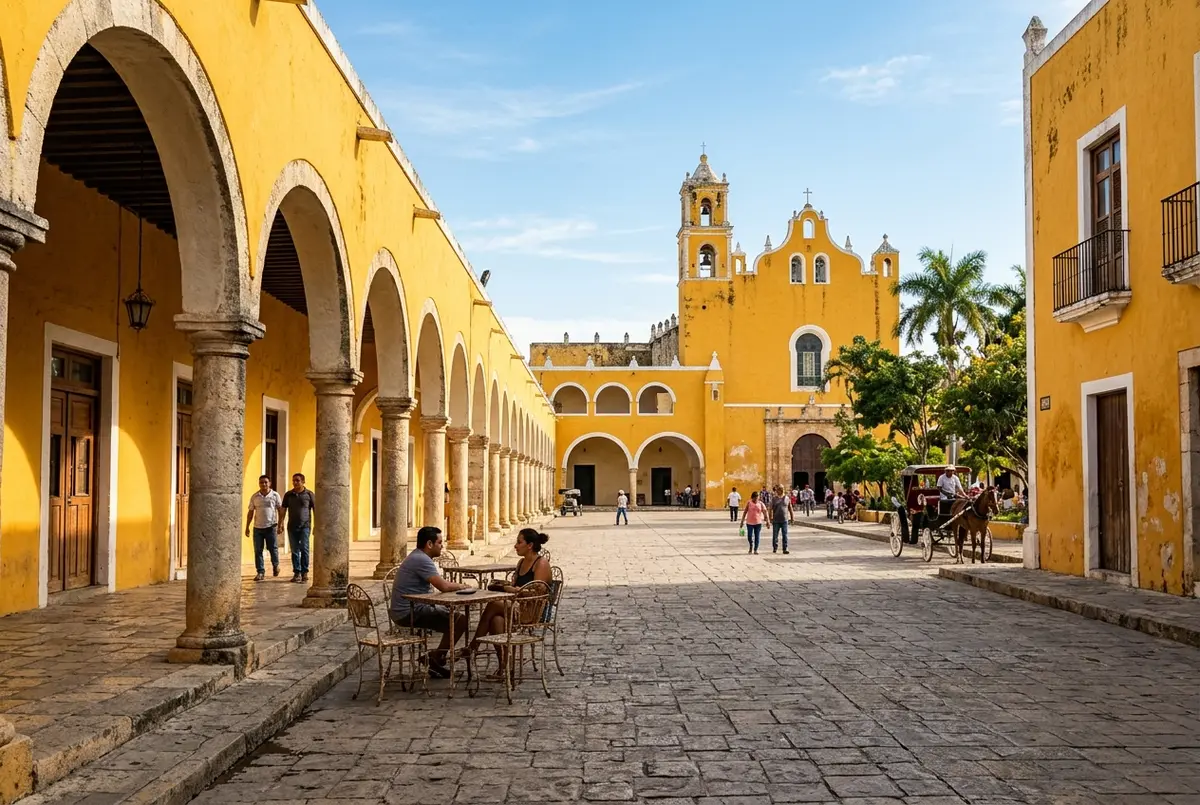
This izamal yellow city guide is for travelers who have heard about the town’s famous color and want to know whether it actually fits their Chichen Itza trip. Nearly every building in Izamal’s historic center, shopfronts, arcades, even the curbs, is painted the same warm ochre yellow, a tradition that goes back generations and gives the whole town a strikingly consistent look you will not find anywhere else in the Yucatan. I would treat it as a destination in its own right rather than a quick photo stop, since there is more going on here than the color alone suggests.
Why is Izamal painted entirely yellow?
The exact origin is debated, but the most common explanation ties the color to the 1993 papal visit of John Paul II, when the town repainted itself in a unified ochre shade for the occasion and simply kept it that way afterward. I find that story more charming than most tourism legends precisely because it is relatively recent and well documented, rather than an invented ancient tradition. Whatever the origin, the effect today is a town that photographs beautifully in almost any light, especially the late afternoon sun.
What is the one landmark I should not skip in Izamal?
The Convento de San Antonio de Padua, a massive 16th-century Franciscan convent built directly atop the platform of a former Maya pyramid. Yes, this is worth prioritizing over everything else in town if your time is limited. Its enormous atrium, one of the largest in the Americas, and the sheer scale of the structure against the yellow buildings around it make it the single image most visitors leave with, and I would walk straight there before wandering anywhere else.
Is it true the convent was built on top of a pyramid?
Yes, and I think that detail is what actually makes Izamal more than just a pretty paint job. Spanish colonizers built the convent directly on top of an existing Maya pyramid platform, a pattern repeated at several sites across Mexico as a deliberate statement of religious and political dominance. Walking up to the convent’s entrance, you are literally climbing what remains of the pyramid’s base, which I find far more interesting than the color scheme alone.
What should I know about Izamal’s honey production?
Izamal sits in a region known for traditional Yucatecan honey production, and several local operators run small honey-tasting stops where you can sample different varieties and learn how the bees are kept. The Chichen Itza, Cenote & Izamal tour from Merida builds a community-based stop into its itinerary alongside the town visit, which I think adds a layer of local culture that a purely architectural walk through the yellow streets would miss on its own.
How does a horse-drawn carriage ride fit into a visit here?
Izamal is small and flat enough that a horse-drawn carriage, locally called a calesa, is a genuinely practical way to see the town, not just a tourist gimmick. I would book one if your stop is short and you want to cover the convent, the main plaza and a few side streets without burning your limited time on foot in the heat. For a longer, unhurried visit, walking is just as easy, since nothing in the historic center sits more than a few minutes apart.
Why does Izamal pair better with Merida than with Cancun?
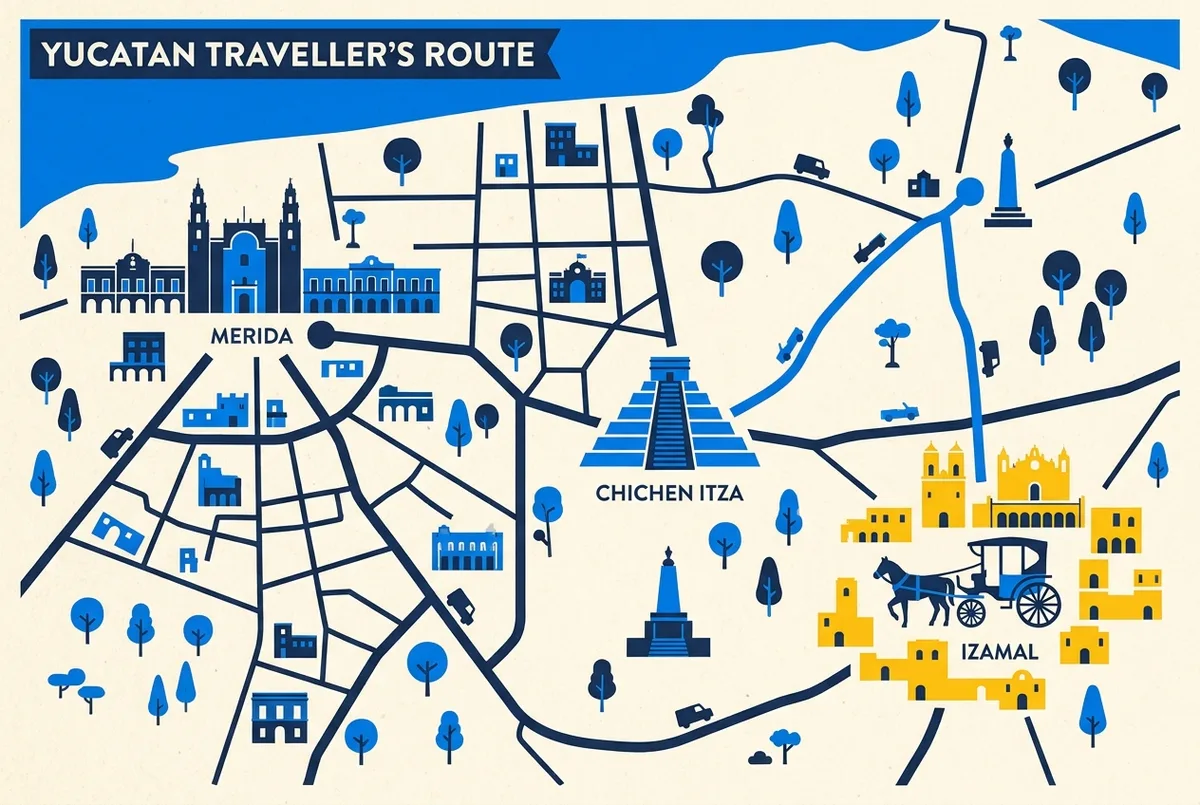
Simple geography. Izamal sits much closer to Merida than to the coast, so a Merida-based itinerary can fold in Izamal without adding significant extra driving, while a Cancun or Riviera Maya departure would need to cover considerably more ground to reach it. I would not try to bolt an Izamal stop onto a standard coastal Chichen Itza day trip, since the detour simply does not make geographic sense from that side of the peninsula.
What does a Merida-based tour that includes Izamal actually look like?
The Chichen Itza, Cenote & Izamal tour from Merida runs about 10 hours total, noticeably shorter than most coastal departures, and stops at Chichen Itza, a Mayan cooking demonstration, the Noolha cenote, and finally Izamal itself before returning to Merida. I would book this specific route if you are already based in or near Merida and want more variety than a straightforward ruins-and-cenote day, since the cooking stop and the Izamal visit are not offered on any coastal departure.
How does Izamal compare to Valladolid as a town stop?
They feel quite different despite both being colonial towns near Chichen Itza. Valladolid has more going on in a compact space, food, cenotes, a lively main square, while Izamal trades some of that variety for a slower pace and a far more distinctive visual identity. My Valladolid travel guide covers that side of the comparison in more depth, and I would pick Izamal specifically if atmosphere and photography matter more to you than packing in multiple activities.
Does Izamal pair naturally with Ek Balam too?
Not especially, and I would not force that particular combination. Ek Balam sits closer to Valladolid and the coast, while Izamal pulls toward Merida, so the two rarely fit into the same single-day itinerary without a lot of extra driving. My Ek Balam ruins guide covers that side of the region if a climbable pyramid interests you more than a colonial town, but I would treat Izamal and Ek Balam as alternative add-ons depending on your departure base, not a combinable pair.
Can I reach Izamal by the Tren Maya instead of a tour?
Yes, and this is actually one of the easier nearby stops to reach independently. Izamal has its own Tren Maya station, which makes a self-guided visit realistic in a way that is not really true of Valladolid or Ek Balam from the same starting point. My full guide to Chichen Itza by Tren Maya covers how the rail line connects the ruins and this town if you would rather skip a guided tour for this particular stop. You can read more about the town’s colonial history on Wikipedia.
This site’s overview of towns and stops near Chichen Itza maps out how Izamal fits alongside Valladolid and Ek Balam depending on where you are based, and comparing every Chichen Itza tour available is worth doing before you book, since only the Merida-departure options route through Izamal at all.
What is worth buying as a souvenir in Izamal?
Local honey, sold by the small operators that run the tasting stops, is the thing I would actually bring home from here rather than a generic souvenir. Handwoven textiles and hammocks also show up in a few shops around the main plaza, often at friendlier prices than similar items sold directly outside Chichen Itza itself. I would browse the stalls near the convent rather than rush straight past them, since the selection here feels more locally made than what gets sold at the busier, more tourist-saturated stops on a typical day trip.
Is Izamal worth an overnight stay rather than a quick stop?
If your itinerary allows it, yes, I would genuinely consider a night here rather than treating it purely as a drive-through stop. The town takes on a noticeably calmer character once day-tour groups clear out in the late afternoon, and the convent lit up in the evening, with far fewer people around, is a different experience than the midday version most tours see. I would still base any Chichen Itza visit around a day trip from here if staying overnight, since Izamal’s distance to the ruins is comparable to a Merida-based stay.
My honest recommendation for visiting Izamal
If your trip is centered on Merida or you are passing through on the Tren Maya, I would build in real time here, at least two hours, rather than treating it as a quick photo stop, since the convent alone rewards a slower visit. If you are departing from the coast instead, I would not try to force Izamal into your itinerary and would pick Valladolid or Ek Balam instead, simply because the geography favors them far more. For the specific traveler this page is written for, someone weighing a Merida-based Chichen Itza day, I think Izamal is one of the most rewarding single additions you can make to that trip.
FAQ: Visiting Izamal near Chichen Itza
Why is Izamal called the Yellow City?
Nearly every building in its historic center is painted the same ochre yellow, a tradition most commonly linked to the town’s repainting ahead of a 1993 papal visit.
Is Izamal close to Chichen Itza?
It sits closer to Merida than to Chichen Itza itself, which is why it pairs more naturally with a Merida-based trip than a Cancun or Riviera Maya day tour.
What is the main thing to see in Izamal?
The Convento de San Antonio de Padua, a 16th-century Franciscan convent built directly on top of a former Maya pyramid platform.
Can I visit Izamal without a tour?
Yes, Izamal has its own Tren Maya station, which makes an independent visit realistic if you are not already booked on a guided itinerary.
I would treat Izamal as the right choice specifically for Merida-based travelers rather than a universal add-on, and once that geography clicks, deciding whether to include it becomes a much easier call.